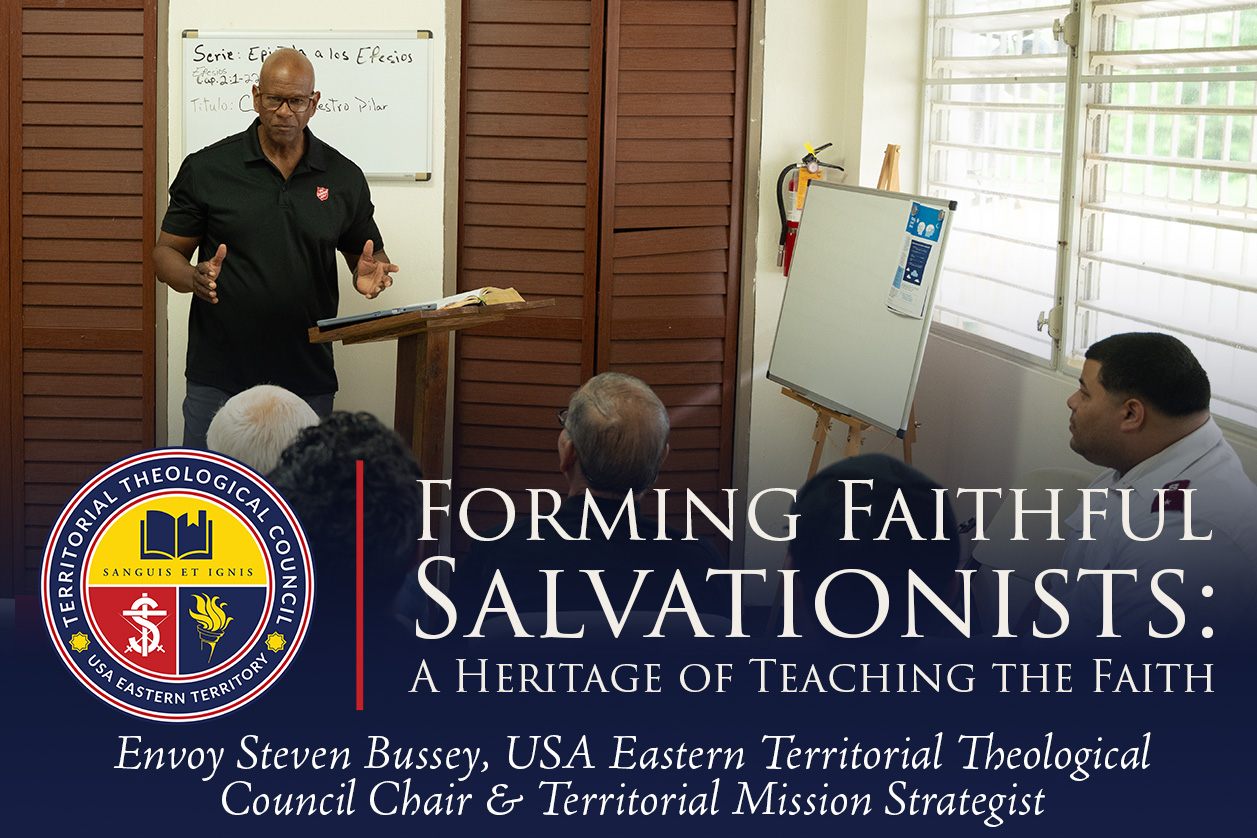
Forming Faithful Salvationists: A Heritage of Teaching the Faith
By Envoy Steve Bussey, USA Eastern Territorial Theological Council Chair & Territorial Mission Strategist
Part 2 of a four-part series from the USA Eastern Territorial Theological Council
Learning to follow Jesus takes time, and we need each other along the way. We need people who will open the Bible with us, answer our questions, pray with us, and help us put our faith into practice. In the first article of this series, we explored catechesis, the Church’s practice of teaching the Christian faith and helping people live it. This practice has deep roots in our Salvationist family. Those roots help explain why we are introducing WE BELIEVE, our deeper catechetical study of the doctrines of The Salvation Army: to help Salvationists know Christ more deeply and become firmly grounded in the Bible and the beliefs we share.

Saint Cyril of Jerusalem (Wikimedia)
From its earliest centuries, the Church understood that becoming a Christian meant learning a new way of life. In Jerusalem during the 300s, a Christian teacher named Cyril helped people connect the truths of Scripture with prayer, forgiveness, turning away from sin, and life within the Church. The faith they were learning was meant to shape their choices, relationships, and love for God.
John Wesley carried this concern into the Methodist revival, a movement that called people to renewed faith and holy living. His Instructions for Children used questions and answers to teach about God, sin, salvation, and holiness. He also taught about the “means of grace,” practices such as prayer and Bible reading through which God strengthens our faith. Wesley urged preachers to make time for children. His Methodist societies and smaller groups, called classes and bands, helped believers encourage one another, speak honestly about their struggles, and grow in obedience to Christ.
This approach was also part of William Booth’s Methodist background. In 1854, Booth studied under Dr. William Cooke in the Methodist New Connexion, a branch of Methodism. Cooke had already written a catechism, a book that teaches Christian beliefs through questions and answers. His A Catechism: Embracing the Most Important Doctrines of Christianity, available in an 1851 edition, was intended for schools, families, and Bible classes. Teaching the faith clearly was part of the tradition in which Booth prepared for ministry.
Army training
William and Catherine Booth carried this concern into the growing Salvation Army. They understood that new Christians and those who had followed Jesus for years needed continuing help to understand their faith and live it. People entrusted with leading others also needed preparation to teach the Bible and set a faithful example.
One early expression of this commitment was the training of cadets, people preparing to become Salvation Army officers. The Doctrines and Discipline of The Salvation Army was prepared for the Training Homes in 1881. Because it was initially circulated mainly among those being trained, critics accused the Army of teaching from a “secret book.” A public edition went on sale in 1883. Catherine Booth explained that it was a “catechism prepared specially for our cadets, of the simplest and most understandable nature, setting forth our doctrines.” Behind the suspicion was a straightforward purpose: helping future officers understand Christian truth and put it into practice.
Learning for all ages
That same care extended to children. Company meetings brought them together in small teaching groups, originally planned for 12 children each. By 1890, weekly lessons were appearing with Bible passages and questions. These eventually developed into the International Company Orders, a series of Bible lessons for teachers to use. Teachers were encouraged to help children understand the lessons and respond to God in their daily lives. By the early 1900s, the Salvation Army Directory was also helping children learn Christian beliefs, including answers they could remember and carry with them.
Young people received further opportunities through junior cadet brigades, later known as corps cadets. These groups helped young Salvationists study the Bible, understand the Army’s beliefs and way of life, and prepare to serve others. Their studies and progress were regularly reviewed. As they grew in understanding, they were being prepared to take responsibility within their local Salvation Army church and its mission.
Adult soldiers, the Army’s committed members, needed this care too. In How to Do a Soldiers’ Meeting (1899), William Booth warned that a lack of understanding could leave Christians struggling to resist temptation and remain faithful. He called for weekly teaching that would strengthen their faith and help them serve. One aim expressed the heart of it: “To bring God nearer to every Soldier, and to bring every Soldier nearer to God.” These meetings brought together teaching, prayer, encouragement, and opportunities for soldiers to offer their lives afresh to God.
Through these different groups, the Army sought to help people of every generation understand the same faith and live it together. Across nations and cultures, Salvationists were learning to love God, grow in holiness, support one another, and lead others to Christ.
WE BELIEVE
We share that responsibility today. Some of us have known the Army’s teachings since childhood; others are discovering them for the first time. All of us have room to grow. WE BELIEVE invites us to study Scripture and deepen our understanding of the Army’s 11 doctrines, our shared statements of Christian belief. We want to understand what we believe, why we believe it, and how these truths shape our homes, relationships, choices, and service.
Our history reminds us that teaching the faith is an act of love. We pass on what we have received because we care about one another and the generations who will follow us. As we introduce WE BELIEVE, we pray that God will deepen our understanding of His Word, strengthen our love for Christ, and help us live faithfully together — for the glory of God and the salvation of the world.