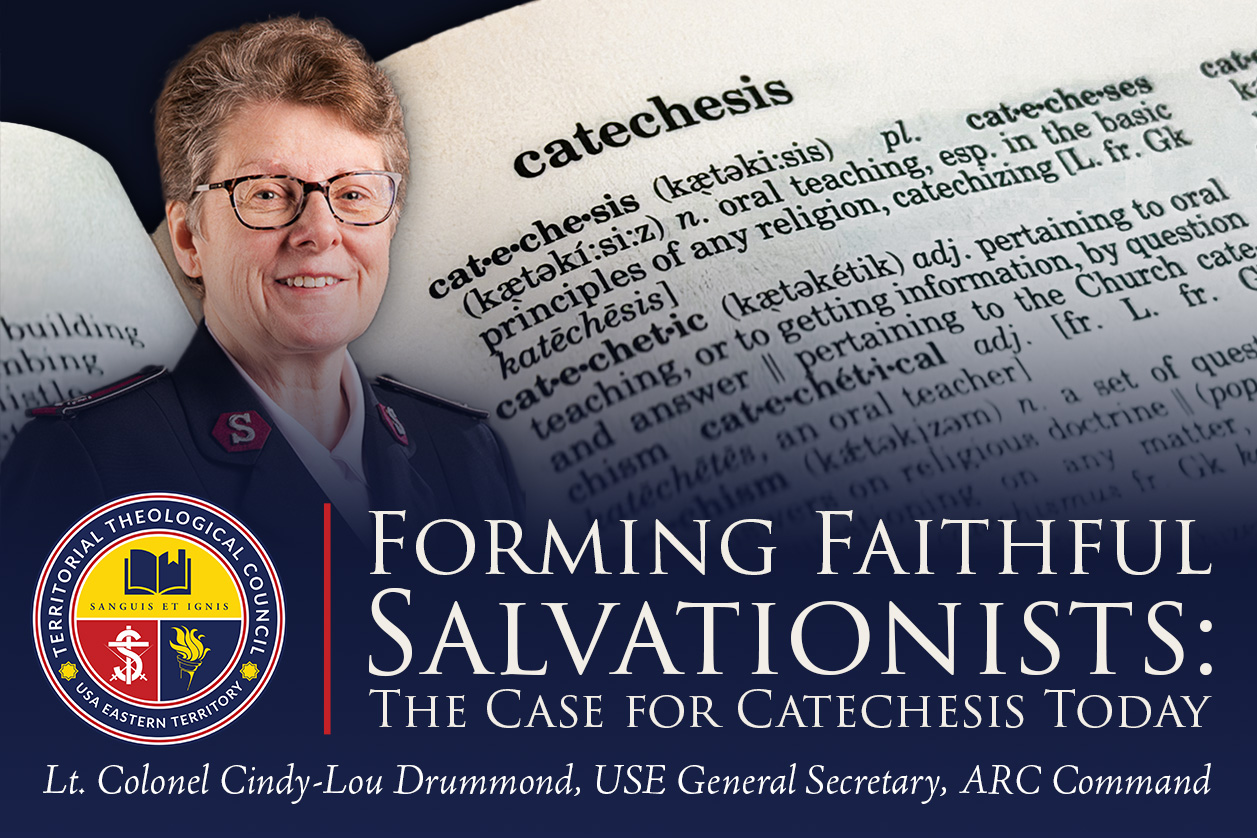
Forming Faithful Salvationists: The Case for Catechesis Today
By Lt. Colonel Cindy-Lou Drummond
“You have heard me teach things that have been confirmed by many reliable witnesses. Now teach these truths to other trustworthy people who will be able to pass them on to others.” —2 Timothy 2:2, NLT
In first-century Israel, it was not uncommon for a community to hire a teacher, also known as a rabbi, to teach the children in a school associated with a synagogue. Children were tutored by the teacher from the age of 4 or 5 to age 12. They were taught to read and write by reading and writing scripture. They also had to memorize scripture. By age 12, boys had to memorize the entire Torah, and girls had to memorize Deuteronomy, Psalms, and Proverbs.
Traditionally, only boys who were able to accomplish this feat advanced to the next level between the ages of 12 and 15. This level concentrated on an explanation of the Torah and gave them an opportunity to ask questions and to have questions asked of them. They continued to study the Hebrew scripture and other writings. If the student excelled in this phase, Beth Midrash or House of Explanation, he would seek an outstanding rabbi who would continue to teach him. The students were called the talmidim or disciples of the rabbi. The talmid (disciple) was so devoted to his rabbi that he adopted his teacher’s way of life, beliefs, character, and practices. His goal was not merely to gain knowledge but to become like his teacher and eventually teach others. This model of intentional formation provides a helpful parallel for understanding Christian discipleship today.
Forming disciples who know, love, and follow Christ
People who are disciples of Jesus learn about Him through the study of God’s Word, the Bible, through doctrinal instruction, and by examples of Christian living. The church employs an intentional method of teaching disciples. We use the word “catechesis” (kat-uh-KEE-sis) for that spiritual instruction.
Catechesis means “to instruct” or “to teach orally.” This is the intentional process of teaching the Christian faith and forming a Christlike character. Like the rabbi teaching the talmid, mature Christian disciples pass on their faith and knowledge to those who desire to become more like Jesus. In doing so, they help shape how disciples think, live, worship, and serve.
While Sunday school provides valuable foundational knowledge of Scripture and introduces people to God, catechesis goes a step further. It intentionally forms disciples through doctrinal instruction, spiritual disciplines, Christian community, and practical obedience to Christ. Catechesis forms disciples who know Christ, love Christ, and follow Christ.
Why is catechesis important today? Many people will say they believe in Jesus but are unclear about Christian beliefs. In fact, there are people who profess to be Christ followers but have allowed secular standards and their own opinions to inform the way they live, think, and believe. Competing worldviews, lack of understanding of basic Christian beliefs, and lack of confidence in what one believes are reasons why catechesis is not only important but necessary today. The intentional formation that results from catechesis empowers the believer to answer with confidence questions about God, salvation, scripture, holy living, and God’s mission in the world. While catechesis is essential for every Christian tradition, it holds particular significance for The Salvation Army because of our emphasis on doctrine, holiness, and mission.
Nominal (in name only) Christianity is not an option for the Salvationist. The Salvation Army’s infrastructure consists of holy living, doctrine, and mission. The effectiveness of The Salvation Army is contingent upon the spiritual fortitude of all Salvationists. The Eastern Territorial Theological Council has developed the catechesis for Salvationists, taking a deep dive into the 11 doctrines, based on scripture, providing a Wesleyan perspective, and teaching us how to live what we confess. This is for every Salvationist for intentional discipleship. As Salvationists, we must know not only what we do and believe, but why. Catechesis synthesizes doctrine, holiness, mission, and service for the Salvationist, rooting us in our identity.
We are bombarded by elements like social media, culture, and everyday experiences that form what we believe. The question is, Who or what is forming you? Catechesis is more than a method of instruction; it is the intentional formation of disciples who know Christ, love Christ, and live out His mission. As Salvationists, we are called not simply to profess faith but to embody it. Through catechesis, we are equipped to remain rooted in biblical truth, grow in holiness, and faithfully serve a world in need of the gospel.