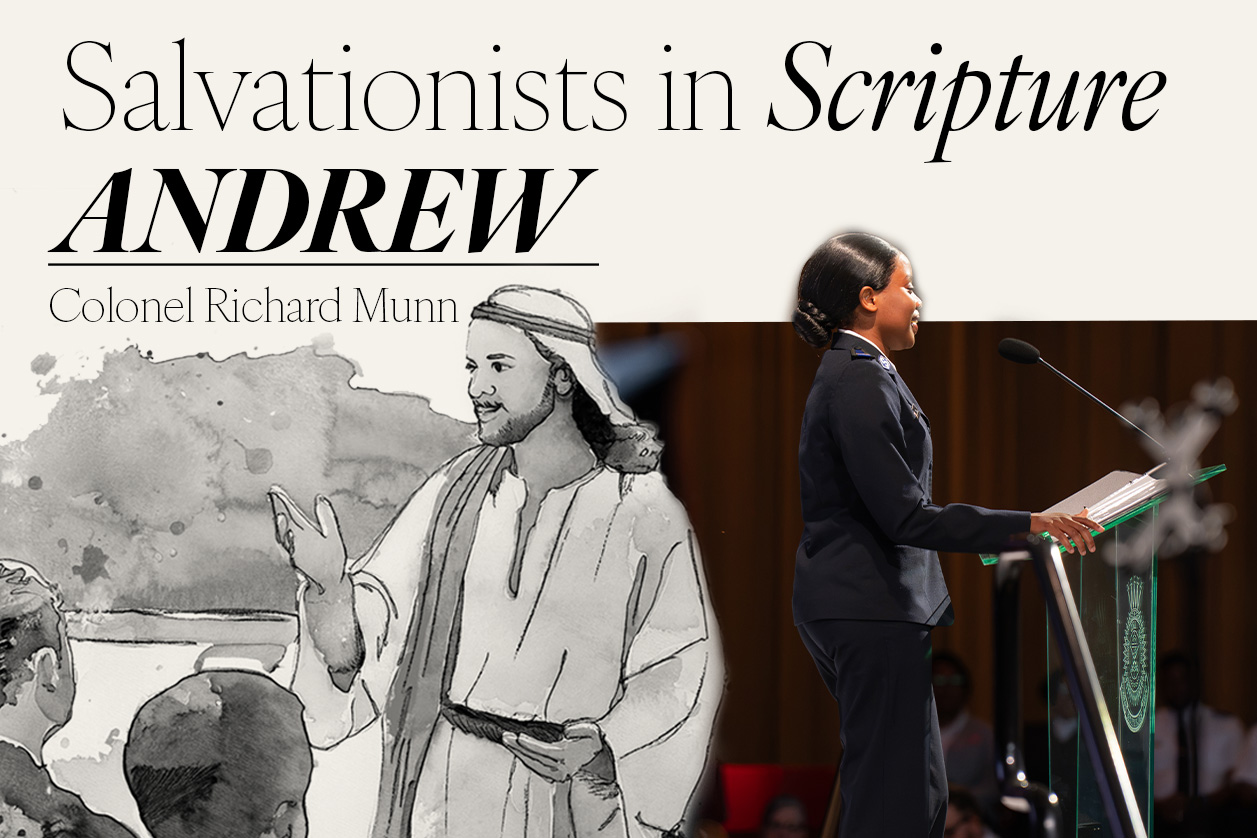
Salvationists in Scripture: Andrew
by Colonel Richard Munn
Within the pages of the greatest story ever told, we find a cast of larger-than-life characters from diverse regions and times. Some of them embody “Salvationism.” That is, the story of their lives and their values represent the essence of Salvation Army word and deed. We might playfully say that they are “Salvationists in Scripture.” Over the course of 2026, we’ll look at 10 people in the Bible who exude Salvationist attributes, from Amos to Andrew, Luke to Lydia, and Micah to Mary. Come back each month as we build our Salvation Army Scripture Hall of Fame.
Salvationists in Scripture
9. Andrew: Natural Evangelist
Evangelism is “one beggar telling another beggar where to find bread,” famously writes Sri Lankan evangelist D.T. Niles.
The phrase is arresting because it connotes communicating the gospel from a shared simple need rather than the notion of artificial sales tactics, cold-calling on doors, or slick corporate-style campaigns.
Evangelism is where the disciple Andrew excels. Three times in the Gospels he is mentioned as bringing someone to Jesus — his own brother Simon Peter, a young boy with five loaves and two fish, and a group of earnest Gentile Greeks. The Gospel of John records the perfect evangelism dynamic: “Andrew took Simon to Jesus” (John 1:42, NLV). Here is a real pattern of ministry, which he does with natural ease. In the parlance of today, we would say Andrew has the spiritual gift of evangelism.
Present throughout the 14,000 corps across The Salvation Army world we have such evangelists, and how we thank God for them. They are seemingly hardwired to think unceasingly in terms of introducing people to Jesus. Church Growth scholar Peter Wagner calls them our “frontline marines” and estimates that 10% of the body of Christ are so spiritually gifted. For these soldiers, introducing someone to Christ is the height of mission and nothing brings them more joy. Without exempting any one of us, how we need them.
The practice of evangelism for many is discomforting, even feared, and yet remains a vital component within any healthy community of faith. This may be especially so for Salvationists around the world, where evangelism towers as an essential narrative in our history and remains as our continued raison d’etre, “a permanent mission to the unconverted.”
Anglican evangelist Michael Green once quipped, “Nothing disheartens the evangelist preacher more than the beaming faces of the saints,” and Archbishop William Temple wryly notes, “The Church is the only cooperative society in the world that exists for the benefit of its non-members.”
The apostle Andrew, and our vibrant evangelists, would agree.
Don’t miss Salvationists in Scripture: Amos.