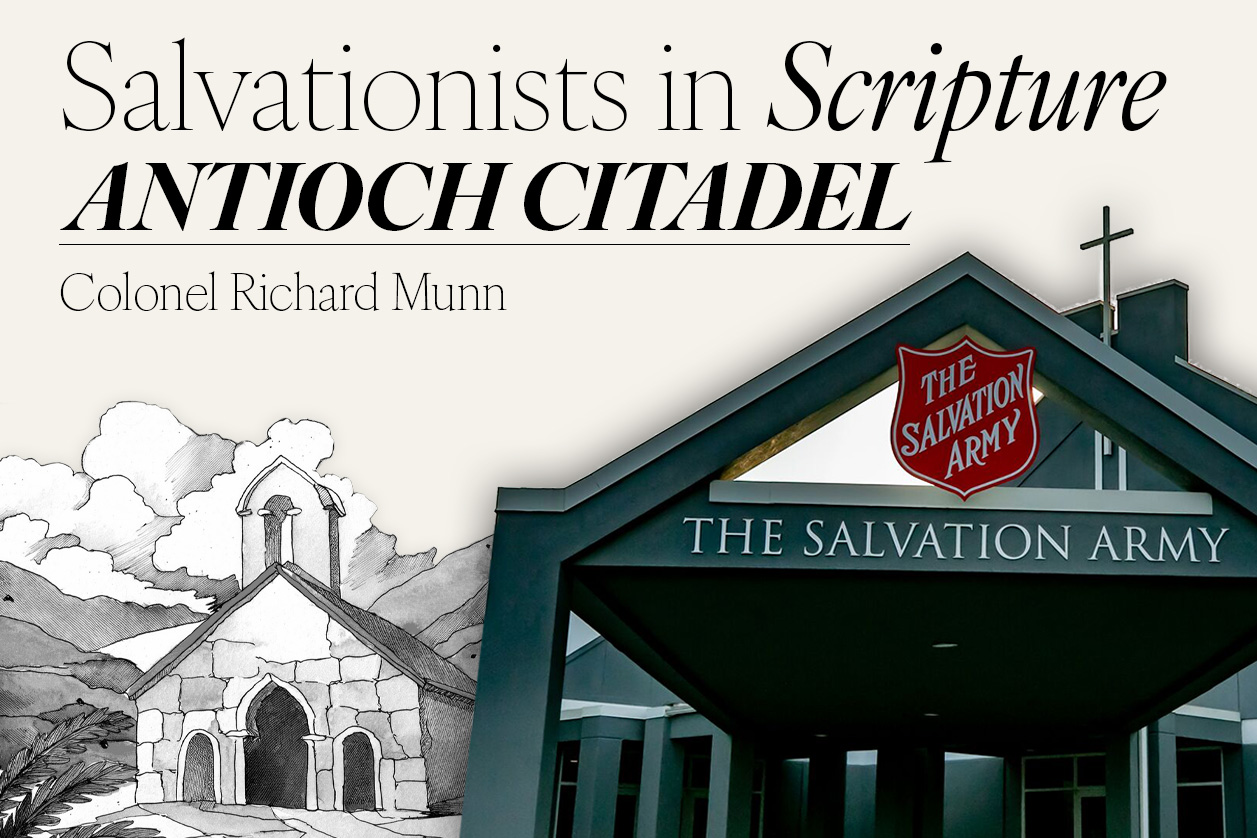
Salvationists in Scripture: Antioch Citadel
by Colonel Richard Munn
Within the pages of the greatest story ever told, we find a cast of larger-than-life characters from diverse regions and times. Some of them embody “Salvationism.” That is, the story of their lives and their values represent the essence of Salvation Army word and deed. We might playfully say that they are “Salvationists in Scripture.” Over the course of 2026, we’ll look at 10 people in the Bible who exude Salvationist attributes, from Amos to Andrew, Luke to Lydia, and Micah to Mary. Come back each month as we build our Salvation Army Scripture Hall of Fame.
Salvationists in Scripture
7. Antioch Citadel: Mission Station
Nestled in the middle chapters of the Book of Acts, we find a throbbing, thriving local community of faith in the city of Antioch. Even today, Antioch is often cited as the very model of a healthy church.
Of particular interest for our purposes, the characteristics exhibited by the church in Antioch embody the same values The Salvation Army aspires to display in our corps communities of faith around the world.
We might smile and think of it as Antioch Citadel.
To start with, the ethnically diverse local congregation in Antioch experiences a move of God: “The Lord’s hand was with them, and a great number of people believed and turned to the Lord” (Acts 11:21). This catches the attention of headquarters in Jerusalem, and soon Paul and Barnabus are teaching, for a whole year no less. My goodness, quite the special guests.
Not content with stasis, the congregation gets a sense all this needs to go onward and outward, and so Antioch becomes the launching pad for Paul’s historic inaugural missionary journey. For the first time, the gospel is officially on the move to other faraway lands.
Remarkably, aware that a famine is imminent in Judea, these vibrant believers arrange for a collection and give the cash to Paul as he leaves. We might say, World Services.
General John Gowans often exhorted Salvationists to see our corps as “Mission Stations,” with every soldier a “missioner.” Antioch is our aspirational corps model — spiritually energetic, missional, multiethnic, and instinctively generous, with a global worldview.
One final exclamation point — this is a congregation composed of both Jewish and Gentile believers. The scenario is so shockingly novel, never before seen, that a new name is coined: “The disciples were called Christians first at Antioch” (Acts 11:26).
Now that is a corps building plaque worth dedicating.
Don’t miss Salvationists in Scripture: Lydia.