Salvationists in Scripture: Micah
by Colonel Richard Munn
Within the pages of the greatest story ever told, we find a cast of larger-than-life characters from diverse regions and times. Some of them embody “Salvationism.” That is, the story of their lives and their values represent the essence of Salvation Army word and deed. We might playfully say that they are “Salvationists in Scripture.” Over the course of 2026, we’ll look at 10 people in the Bible who exude Salvationist attributes, from Amos to Andrew, Luke to Lydia, and Micah to Mary. Come back each month as we build our Salvation Army Scripture Hall of Fame.
Salvationists in Scripture
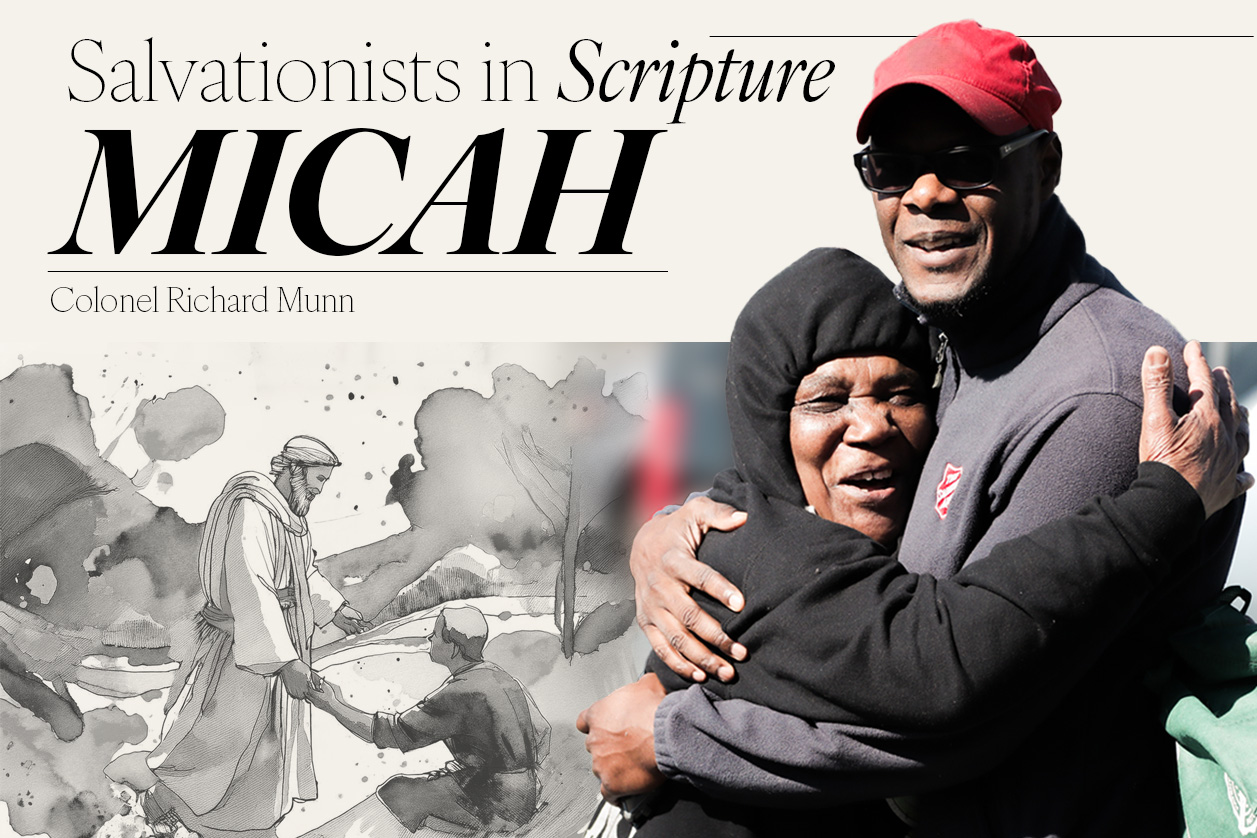
2. Micah: Social Justice Champion
Micah, the “Poor Man’s Prophet,” is a commoner who never strays from his roots. He rails against corrupt leaders and indifferent clergy. Serving outside the center of national and religious power, he consistently advocates for the lowly, the outcast, and the oppressed.
As such, he embodies a primal Salvationist value. In today’s language, we would call him a social justice champion — and embedded across our Salvation Army world we also have these poor man’s heroes who are tough, tenacious, and tender. In the social justice community, there are two polarities: the dignified ambassadorial representative who lobbies with agency executives and government officials; and the front-line restless, agitated champion of the poor. Micah is decidedly the latter.
A straight talker, to say the least, he lambastes those who “covet fields and seize them, and houses, and take them. They defraud people of their homes, they rob them of their inheritance” (Micah 2:2).
Here is a DNA link with The Salvation Army, and maybe William Booth in particular, who never strayed from his working-class roots, calling the oppressed and broken “our people.” In an uncannily similar manner, Booth envisioned the deployment of a “poor man’s lawyer,” providing free legal counsel to those he saw suffering systemic oppression from lack of resources or know-how. Micah would agree.
The openings for The Salvation Army to serve as advocates for the powerless of our world are innumerable, from the elderly widow whose landlord excessively hikes up the rent, to the childlike girl coerced and trapped in human trafficking, to the prematurely incarcerated teenage boy who just needs a second chance. To the Army, while the powerful might cluck, the tenement cheers.
Micah sees the great love of God and His justice as inseparable, very Salvationist. His theme is often memorized, a perfect three-point sermon outline: “And what does the Lord require of you? To act justly and to love mercy and to walk humbly with your God” (Micah 6:8).
He, and Salvationists across the world, might well sing the plaintive Disney song (from Hunchback of Notre Dame): “God help the outcasts, or nobody will.”
Our social justice champions will.
Don’t miss Salvationists in Scripture: Joshua.